
Review & get 10% off
Review this product and we’ll give you 10% off your next purchase. Write a review →
We offer 10% off your next purchase for every honest review, positive or negative.
Thank you for your review!
Here is 10% off your next purchase:
One use per customer. Cannot be combined with other offers.
We offer 10% off your next purchase for every honest review, positive or negative.
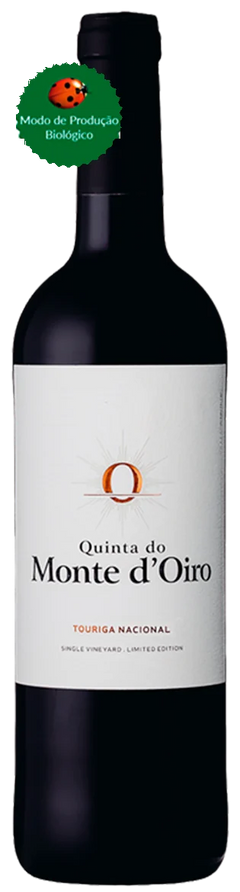
Quinta do Monte d'Oiro Touriga Nacional 2022
Quinta do Monte d'Oiro Touriga Nacional 2022 - 2022 is backordered and will ship as soon as it is back in stock.
Buy a case of 6 and save 10%
€23.35
per bottle
€155.70
€140.13
case of 6
Discount applied automatically in the cart. Cannot be combined with other codes.
- Free shippingfrom €80
- Secure paymentSSL · MB Way · card
- Returns14 days
- KlarnaPay in 3, interest-free

Quinta do Monte d'Oiro Touriga Nacional 2022 - 2022 is backordered and will ship as soon as it is back in stock.
TECH SHEET
Tap any tile to learn more
- Vintage
- 2022
- Country
- PortugalPortugal
- Region
- Lisboa
- Type
- Red
- Producer
- José Bento dos Santos
- Winemaker
- Antigo Braga
- Grapes
 Touriga Nacional100%
- Alcohol
- 13.5% vol.
- Bottle
- 750 ml

Vintage
2022
4 years
Red wine: fermented on the skins, which give colour, tannin and structure.
Region · Portugal
Lisboa
Atlantic- and river-influenced regions around Lisbon and the Tagus valley. A wide range of grapes and styles, from fresh whites to full reds.
Type
Red
Red wine: fermented on the skins, which give colour, tannin and structure.
Producer
José Bento dos Santos
Lisboa, Portugal
- Region
- Lisboa, Portugal
- Winemaker
- Antigo Braga
Grapes
Grapes in this wine
- Touriga Nacional100%
Portugal’s flagship red. Floral (violet) and black-fruit aromas, deep colour, firm tannins and great ageing potential.
See wines with Touriga Nacional
Alcohol
13.5% vol.
ABV shows the % of alcohol by volume.
Guide scale for wine — suggestion by style.
Bottle
750 ml
≈ 6 125 ml glasses
Wine profile
Body
This wine: 4 out of 5 — closer to «full».
How heavy and full the wine feels in your mouth — from light like skimmed milk to rich like cream. It comes mainly from alcohol, extract and, in sweet wines, sugar.
Wine profile
Tannin
This wine: 4 out of 5 — closer to «firm».
Tannins come from grape skins, seeds and oak. You feel them as a pleasant drying grip on gums and tongue — from silky and velvety to firm and chewy.
Wine profile
Acidity
This wine: 5 out of 5 — closer to «crisp».
The freshness that makes your mouth water, like a squeeze of lemon. It gives a wine tension, length and ageing potential, and makes it great with food.
Wine profile
Alcohol
This wine: 4 out of 5 — closer to «high» (13.5% vol.).
Alcohol brings warmth and body. Still wines usually sit between about 11% and 15% ABV, while fortified wines such as Port sit around 19–20%.
Wine profile
Sweetness
This wine: 1 out of 5 — closer to «dry».
The residual sugar you can taste. EU label guide for still wines: dry up to ~4 g/L, medium-dry up to ~12 g/L, medium-sweet up to ~45 g/L, sweet above that.
Wine profile
Red
Tap or hover a scale
Typical: average of 720 reds at Vinogrande
Critics & awards
- Robert ParkerWine Advocate
- James Suckling
- Revista de Vinhos20-point scale
Not sure? Ask our AI Sommelier NEW
Pairings, alternatives and advice in seconds
Description
Quinta do Monte d'Oiro Touriga Nacional 2022 is a benchmark organic red made by José Bento dos Santos in the prestigious Lisboa wine region (Alenquer). This single-varietal wine expresses the elegance of Touriga Nacional on a terroir strongly influenced by the Atlantic climate and clay-limestone soils.
Quinta do Monte d’Oiro Touriga Nacional 2022 shows remarkable aromatic concentration combined with singular elegance and delicacy. On the nose, notes of ripe cherry stand out, with subtle floral hints and spicy nuances of clove and sage. On the palate it shows a silky texture, great freshness and exemplary balance, where flavours of cherry, bitter cocoa and fine spice come together harmoniously. Precise, vibrant acidity gives energy and liveliness, while firm but refined tannins ensure structure and depth. The finish is long, persistent and sophisticated, confirming the distinctive personality of this Touriga Nacional.
Food pairingFood Pairing: A red with a strong gastronomic vocation, ideal with grilled red meats such as a veal steak or a large rib chop, as well as oven-roast kid and lamb. Its structure and aromatic complexity also go well with game dishes, such as wild boar or venison stews, and with the richness of a traditional duck rice. For something more relaxed, it's perfect with cured sheep's cheeses and smoked sausages, whose intensity finds a worthy partner in this wine.
What to serve with this wine
Dishes calculated from this wine’s profile, grapes and region.