Guide · New Year's Eve
By Vinogrande · 7 min read
At midnight, nobody asks what is in the glass. But everyone notices when the bubbles are fine, the bottle is cold and the cork comes out without a bang.
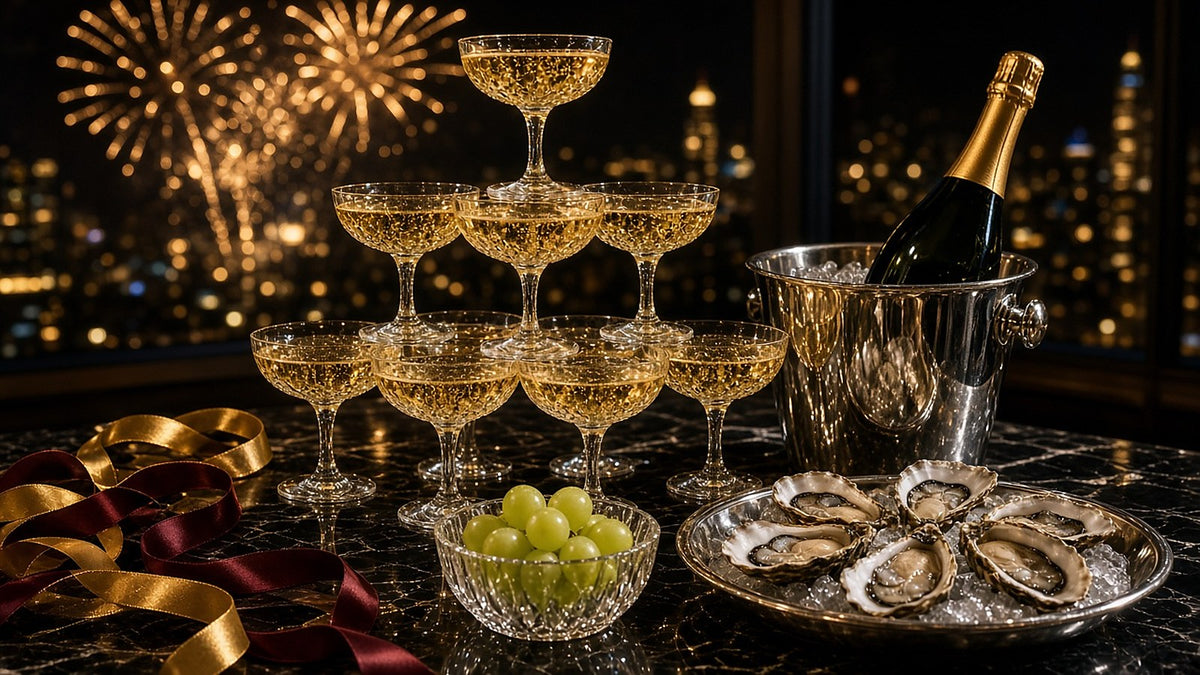
The last night of the year has its own soundtrack: twelve chimes, twelve raisins or grapes, and the sound of a cork. It is also the night when more sparkling bottles are opened than any other. It is worth choosing well.
Sparkling wine, Champagne, Cava: they all have natural bubbles, but they are not the same thing. Here is what you need to know to choose, serve and open the right bottle.
At a glance
— Champagne only comes from the Champagne region in France. Cava is a Spanish appellation. Sparkling wine is the general term, and Portugal has excellent examples from Bairrada and Távora-Varosa.
— The best ones undergo their second fermentation in the bottle: the classic or traditional method.
— Brut Nature and Extra Brut are the driest; Brut is the most common style.
— Serve at 6–8 °C, in a flute or tulip glass, and open the bottle by turning the bottle, not the cork.
The differences
Three names, one principle
All these wines get their bubbles the same way: a second fermentation in a closed vessel, which traps the carbon dioxide. The differences lie in origin, grape varieties and method.
- Champagne: only sparkling wine from the Champagne region, made by the traditional method, mainly from Chardonnay, Pinot Noir and Pinot Meunier, may use the name.
- Cava: a Spanish appellation, mostly in Catalonia, also made by the traditional method. Some historic producers have since created their own, stricter designations.
- Portuguese sparkling wine: Bairrada and Távora-Varosa are the benchmark regions. Baga, Arinto, Bical and Chardonnay give very fresh sparkling wines, often at hard-to-beat value.
Fine bubbles are not a whim: they are a sign of time. The longer the wine spends on its lees, the more delicate and creamy the mousse.
The label
Brut, Extra Brut, Brut Nature: what it means
These terms indicate how much sugar the wine contains and are defined in EU law. From driest to sweetest:
| Term | Sugar (g/l) | For whom |
|---|---|---|
| Brut Nature | under 3 | Lovers of very dry, pure wines |
| Extra Brut | 0 to 6 | Aperitif and seafood |
| Brut | under 12 | The most versatile style |
| Extra Dry | 12 to 17 | A hint of sweetness |
| Dry (Sec) | 17 to 32 | Slightly sweet |
| Demi-Sec | 32 to 50 | Not-too-sweet desserts |
| Doux | over 50 | Desserts |
For midnight, a Brut or Extra Brut pleases most people. If it is going with dessert, a Demi-Sec makes more sense.
Portugal
Three Portuguese sparkling wines for the toast

01
Espumante Filipa Pato 3B Rosé
Baga rosé from Bairrada, traditional method, no dosage sugar. Fresh, pure and remarkable value.
View in shop →
02
Kompassus Espumante Blanc de Noirs
Bairrada Blanc de Noirs, made from red grapes with the input of Anselmo Mendes.
View in shop →
03
Murganheira Vintage 2016 - Estrutura, elegância e frescura sublime
Vintage sparkling wine from Caves Murganheira in Távora-Varosa. Structure, elegance and freshness.
View in shop →Abroad
Cava, Champagne and a vintage

04
Raventós I Blanc de la Finca
Biodynamic Catalan sparkling wine, traditional method, Brut Nature. It left the Cava D.O. for Conca del Riu Anoia.
View in shop →
05
Pierre Gimonnet & Fils Cuis 1er Cru Brut SA
Blanc de Blancs Champagne from Cuis, 1er Cru. Lively, mineral and fresh.
View in shop →
06
Deutz Brut Vintage Millésimé 2018
Vintage Champagne from Aÿ, 2018 harvest: green apple, lemon zest and precision.
View in shop →
The glass
Flute, tulip or coupe?
The tall, narrow flute preserves the bubbles and is the classic choice for a toast. More and more sommeliers prefer a tulip glass, or even a white wine glass, which gives the aromas room, especially in older sparkling wines. The low, wide coupe is beautiful and full of history, but lets the bubbles escape quickly.

07
UNO Perlé Sparkling Conjunto 2 copos
Set of 2 Sophienwald sparkling wine glasses, light and durable, with a built-in mousse point.
View in shop →More options in Sparkling wine glasses.
Opening
How to open the bottle safely
By law, a sparkling wine has at least 3.5 bar of pressure at 20 °C, more than a car tyre. A cork that gets away can hurt someone. So:
Chill the bottle well, to 6–8 °C. A warm bottle has more pressure and more foam.
Remove the foil and loosen the cage, always with your thumb on the cork.
Cover the cork with a napkin and tilt the bottle at about 45°, pointing away from people.
Turn the bottle, not the cork, slowly, until the cork comes out with a sigh, not a bang.
Pour in two goes: a little in each glass, wait for the foam to settle, then top up.

Quantities
How many bottles for the night?
A 75 cl bottle pours about six to eight flutes. If the sparkling wine is just for the toast, allow one bottle for every six people. If it is the wine of the night, allow half a bottle per person. And order in good time: shipping is free from €80 to mainland Portugal, €120 to the Azores and Madeira and €150 to mainland Spain.
See the full selection in New Year's Eve packs and Champagnes & sparkling wines.
FAQ
What people ask us most
What is the difference between sparkling wine and Champagne?
Champagne is a sparkling wine from the Champagne region in France, made by the traditional method. Sparkling wine is the general term for naturally sparkling wines from anywhere.
What is Brut Nature?
The driest sparkling wine, with under 3 grams of sugar per litre and no sugar added at dosage.
What temperature should sparkling wine be served at?
Between 6 and 8 °C. Colder hides the aromas; warmer creates too much foam.
How do I open a bottle without the cork flying?
With a napkin over the cork, the bottle tilted at 45°, turning the bottle rather than the cork.
✦
Bottle chilled, glasses ready, cork under control. Happy New Year.
Shop New Year's Eve packsPlease enjoy responsibly.